Strategic Deep Dive | The Recruiting Guy | GDCF News
🧭 #GDCFNews
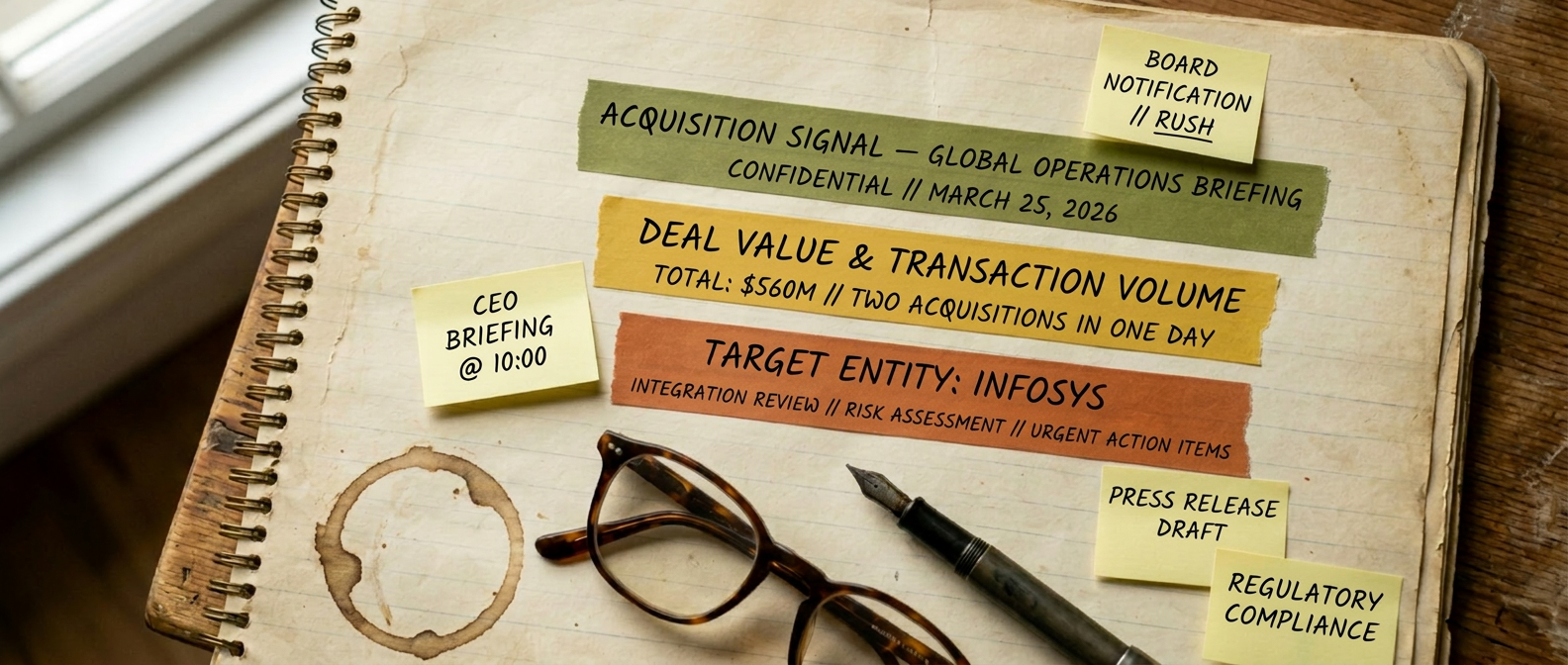
Infosys just spent $560M to make healthcare a priority.
I have watched GDCFs declare healthcare a priority vertical for years.
Infosys just showed what that conviction actually costs.
$465M for Optimum. $95M for Stratus. One day. One thesis.
Here is what they actually bought — and what it means for every firm still trying to build and sell into this space.
🏛️ BRIEF HISTORY
Infosys has spent three decades grinding up the value chain — and the progression matters:
- Phase 1 — Offshore IT delivery engine. Cost arbitrage. Scalable. Commoditized.
- Phase 2 — Global SI at scale. Applications, infrastructure, outsourcing.
- Phase 3 (now) — Consulting-led, platform-enabled transformation firm competing directly with Accenture, IBM, and Cognizant for board-level mandates.
Healthcare has always been a declared priority — and a persistent gap. Highly regulated. Relationship-driven. EHR complexity, payer/provider economics, HIPAA compliance — it is not a vertical you fake your way into.
Infosys’s answer was Infosys Helix — an AI-first core administration and payer platform designed to unify provider lifecycle management, payer-on-cloud, and B2B connectivity across the healthcare ecosystem.
But Helix alone does not win deals. You need field credibility. You need implementation depth. You need trust that was built inside hospital systems over years — not slide decks.
The Helix battle has already gotten ugly. In August 2024, Cognizant’s subsidiary TriZetto filed suit in Texas federal court, alleging Infosys misappropriated proprietary trade secrets from its Facets and QNXT platforms — accessed under NDA — to develop and market Helix as a competing product. Infosys denied the allegations and counterpunched in January 2025, accusing Cognizant of antitrust violations, executive poaching, and deliberate sabotage of Helix’s development timeline. Both claims are active.
👉 That context matters here. This acquisition is not just M&A strategy — it is a competitive answer to a war that is already underway.
📌 WHAT HAPPENED
📍 Two Deals. One Signal.
🏥 Optimum Healthcare IT — up to $465M (all-cash)
Founded in 2012, Jacksonville Beach, FL-based Optimum is a Best in KLAS healthcare digital transformation and consulting firm with reported FY25 revenue of approximately $275.9M and 1,600+ employees. Acquired from PE firm Achieve Partners. Deep specialization in EHR advisory, Epic implementation, provider operations, and clinical and operational managed services for U.S. health systems.
Real client work: moving Baptist Memorial Health Care’s Epic EHR to AWS. Guiding Inova Health System through Epic Beaker adoption. This is trust built over 13 years inside health system boardrooms — not demos.
Partner stack: Elite ServiceNow (2026 Partner of the Year) • Premier AWS • Workday Services • Microsoft Azure
👉 Infosys did not acquire a capability. They acquired a channel — directly into U.S. health system CIOs who already trust this team.
One detail worth noting: Achieve Partners held this asset as a PE-backed platform. Earnout structures in PE exits routinely create 12–24 month retention clocks for key talent. That is not a footnote — that is the real integration risk, and we will come back to it.
🛡️ Stratus — up to $95M (all-cash)
Headquartered in Freehold, NJ. FY25 revenue of $42.8M. 450+ specialists. Delivery footprint across the U.S., Canada, and India. Leading Guidewire Software partner for P&C insurance — PolicyCenter, ClaimCenter, BillingCenter, cloud migrations, data modernization, and managed services.
Stratus is not about headcount. It is about institutional knowledge: which data fields matter for underwriting accuracy, how claims fraud detection actually works in production, why generalist integrators lose these deals the moment they get into a real carrier environment. That expertise takes years to build.
👉 Infosys bought it in a single transaction.
Together — these are not tuck-ins. They are vertical density plays with direct attach points into Helix, Cobalt (cloud), and Topaz (AI).
💡 WHY IT MATTERS
⏱️ Buy What You Cannot Build in Time
Infosys made a clear-eyed decision: spend another 5–7 years building provider and P&C depth organically — or buy it and compress the timeline now.
They bought it.
In regulated industries, access is controlled by trust, track record, and domain fluency — not price, not bench size, not AI messaging. Optimum has 13 years of health system relationships. Stratus has institutional P&C knowledge that defeats generalist approaches the moment you get into production. A firm that can wire APIs together is not the same as a firm that understands which data fields matter for underwriting accuracy and why.
There is also a regulatory tailwind driving urgency. CMS Interoperability and Patient Access mandates are forcing U.S. health systems to modernize EHR connectivity on a regulatory timeline — not a discretionary one. Helix is only relevant to that mandate if it can actually integrate with live Epic environments. Optimum is the execution layer that makes that possible. This is not optional infrastructure — it is compliance-driven transformation with a hard clock on it.
The platform integration story is specific:
- Helix gets a delivery channel into provider workflows — EHR, clinical ops, workforce management — it previously lacked at scale in the U.S.
- Topaz AI gets a deployment pathway inside live health system environments
- Cobalt gets provider-side cloud migration experience across Epic and AWS
- Stratus + Helix creates adjacency into P&C and cross-industry risk workflows where the same data fragmentation and interoperability problems exist
👉 The model is clean: Platform + Domain + Delivery = Enterprise deal velocity.
Most firms talk about that model. Very few can walk into a hospital boardroom or a P&C carrier’s C-suite and execute it. That is what $560M just bought.
🏆 MARKET IMPACT
♟️ The Competitive Chessboard
🔵 vs. Accenture
Accenture already owns the consulting-plus-platform-plus-industry-depth model at enterprise scale — massive healthcare and insurance practices, deep payer and provider relationships. Infosys is not suddenly bigger. But they are sharper. These deals close a provider-side credibility gap that generic delivery scale could never close. Infosys now has access to health system decision-makers that Accenture has to earn through multi-year pursuit cycles.
🔴 vs. Cognizant
This is the most direct hit — and the backdrop of active litigation makes it sharper. Cognizant generates nearly one-third of its total revenue ($5.9B) from healthcare clients. Infosys derives approximately 7.5% ($1.4B) from its Life Sciences and Healthcare vertical. That gap has defined the competitive dynamic for years. The Optimum acquisition flanks Cognizant on the provider side — where TriZetto never played — while Stratus deepens the P&C contest.
👉 Cognizant’s healthcare moat just got narrower.
📡 Signal to the GDCF Pack
The playbook is now visible:
- Buy domain-rich firms in regulated industries
- Wrap them around owned platforms
- Use them to unlock larger, longer, stickier transformation deals
TCS, Wipro, HCL, Capgemini — the calendar just got more urgent. The game is no longer horizontal AI plus generic cloud. It is regulated-industry vertical depth plus platforms plus local U.S. delivery. If you do not control a credible platform and a consulting layer in healthcare and insurance by the end of this cycle, you are renting someone else’s roadmap.
👉 Expect M&A acceleration across healthcare, BFSI, and public sector from every major GDCF that is not already there.
🎯 TALENT + SALES IMPLICATIONS
🎯 The Profile That Wins This Motion
This move changes who gets hired, who gets promoted, and who gets replaced.
The seller who wins in a post-acquisition environment like this is not the generic IT services rep. Not the relationship manager selling rate cards and SLA decks. The winning profile carries three things simultaneously:
- Domain authority — speaks Epic, Guidewire, Workday, ServiceNow in the same conversation, without translators
- Platform fluency — positions Helix and the Topaz/Cobalt stack as the operating spine of a multi-year transformation, not a feature set
- Executive access — calling on CFOs, CIOs, and Chief Medical Officers; closing programs, not projects
That is a rainmaker profile. It is rare, expensive, and already placed somewhere.
⚠️ Why Most Firms Struggle
They separate sales, consulting, and delivery. Buyers do not.
The winning seller connects all three in one conversation — domain credibility as the entry point (EHR modernization, P&C core replacement, network transformation), platform as the expansion play, and full delivery ecosystem behind the close.
Most GDCF sales engines are still built around T&M projects, RFP-driven ADM, and siloed services-only offerings. They do not have enough sellers who carry a platform P&L mindset — pipeline shaped around installed base, attach rate, and expansion, not just new logos.
Infosys now has to solve this fast: align field incentives, build overlay teams, and create solutioning squads that let Optimum and Stratus operate as accelerants — not isolated boutiques inside a large SI machine.
And the PE exit structure adds urgency. Earnout windows create retention clocks. If key Optimum talent hits their payout threshold and walks, the client relationships walk with them. Infosys needs a retention strategy that goes beyond title and compensation — it requires cultural autonomy. Boutique consulting cultures do not survive rigid offshore delivery metrics. That is not a hypothetical. It is a pattern across GDCF acquisition history.
👉 Integration success will be defined less by synergies on a slide and more by whether a small cohort of hybrid consulting-platform rainmakers get unleashed — not managed — across the combined client base.
👉 RECRUITING GUY TAKE
Infosys fixed a structural gap — the missing middle between platform ambition and real-world execution.
They had Helix. They had Topaz. They had global delivery scale.
What they did not have: a seat at the table when a health system CIO decided who was going to rebuild their clinical operations. Or when a P&C carrier’s transformation committee asked who understood Guidewire and their data environment well enough to actually lead the program.
👉 $560M just bought those seats. Now the question is whether they have the discipline to keep the people who earned them.
Chris Wellington
The Recruiting Guy
Business Consulting + Digital Engineering | Talent Market Intelligence | Rainmaker Hiring
SOURCES
🔷 Infosys Press Release — Optimum Healthcare IT Acquisition https://www.infosys.com/newsroom/press-releases/2026/acquire-leading-healthcare-digital-transformation-company.html
🔷 Infosys Press Release — Stratus Acquisition https://www.infosys.com/newsroom/press-releases/2026/acquire-leading-insurance-consulting-technology-company.html
🔷 Fierce Healthcare — Deal Coverage https://www.fiercehealthcare.com/health-tech/digital-health/infosys-acquire-optimum-healthcare-it-465m-deal
🔷 Business Standard — Cognizant v. Infosys Litigation Timeline https://www.business-standard.com/companies/news/infosys-cognizant-texas-court-ravi-kumar-it-trizetto-helix-125030600967_1.html
🔷 Futurum Group — Stratus Strategic Analysis https://futurumgroup.com/insights/stratus-acquisition/
🔷 Infosys Helix — Platform Overview https://www.infosys.com/products-and-platforms/infosys-helix/overview.html